Catlog AI Assistant
Turning Instagram conversations into a more reliable commerce workflow.
Details
Overview
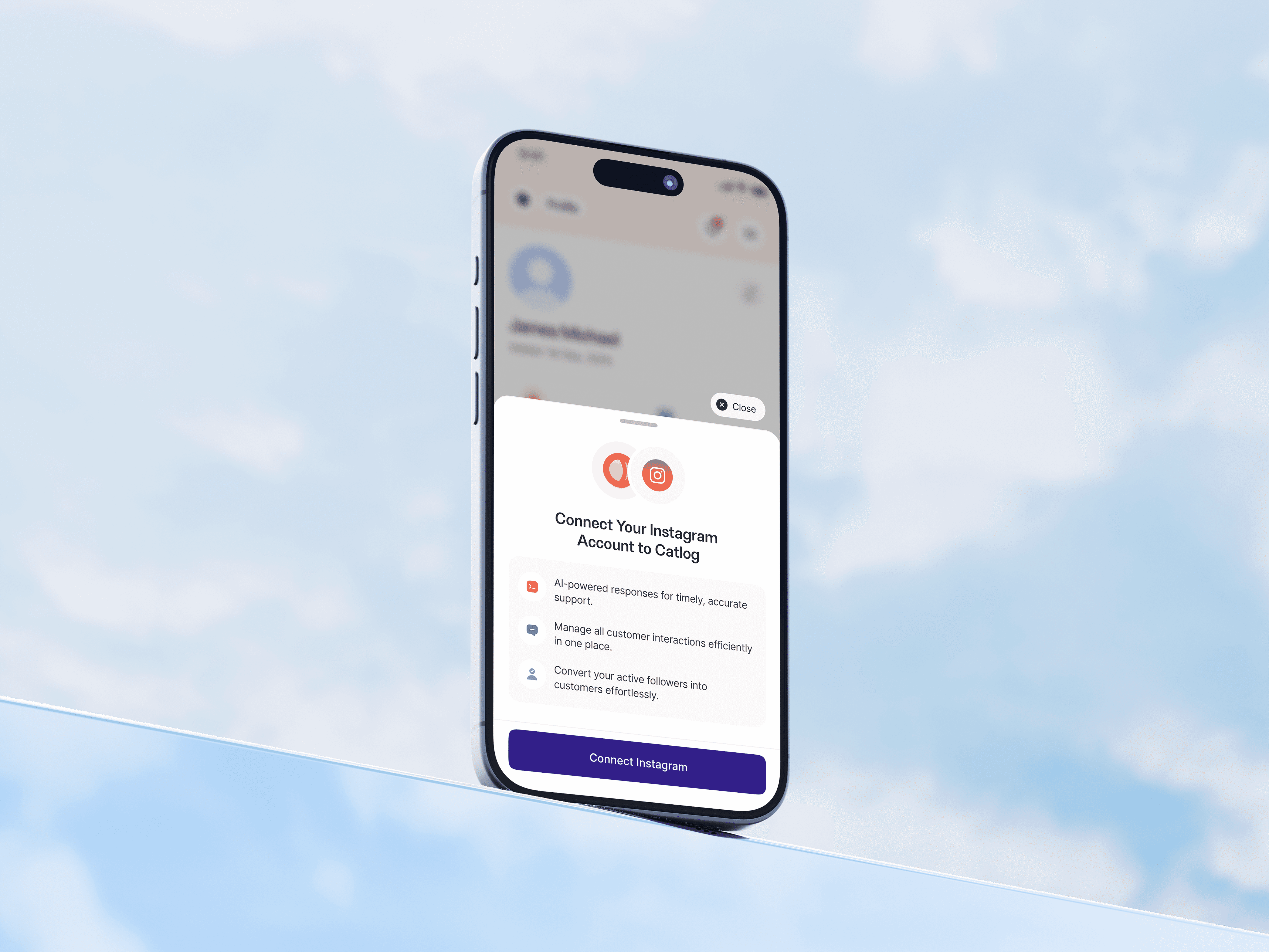
Catlog AI Assistant was designed for African small businesses that sell primarily through Instagram DMs. For these merchants, Instagram isn't just a communication channel — it's the storefront, sales flow, and relationship layer all at once. Customers ask questions in chat, confirm availability, discuss delivery, and complete purchases through conversation.
The project focused on overhauling Catlog's marketing website to improve clarity, strengthen conversion, and better surface the platform's expanding capabilities.

Understanding the Problem
With a small timeline and a small team, we didn't run a formal research program. Instead, I combined secondary research — existing literature on social commerce behaviour in West Africa, competitive analysis of tools in the space, and publicly available data on Instagram commerce patterns — with informal conversations with merchants who sell on Instagram. Those weren't structured interviews. They were loose, honest exchanges with people running real businesses, and they were useful precisely because of that.
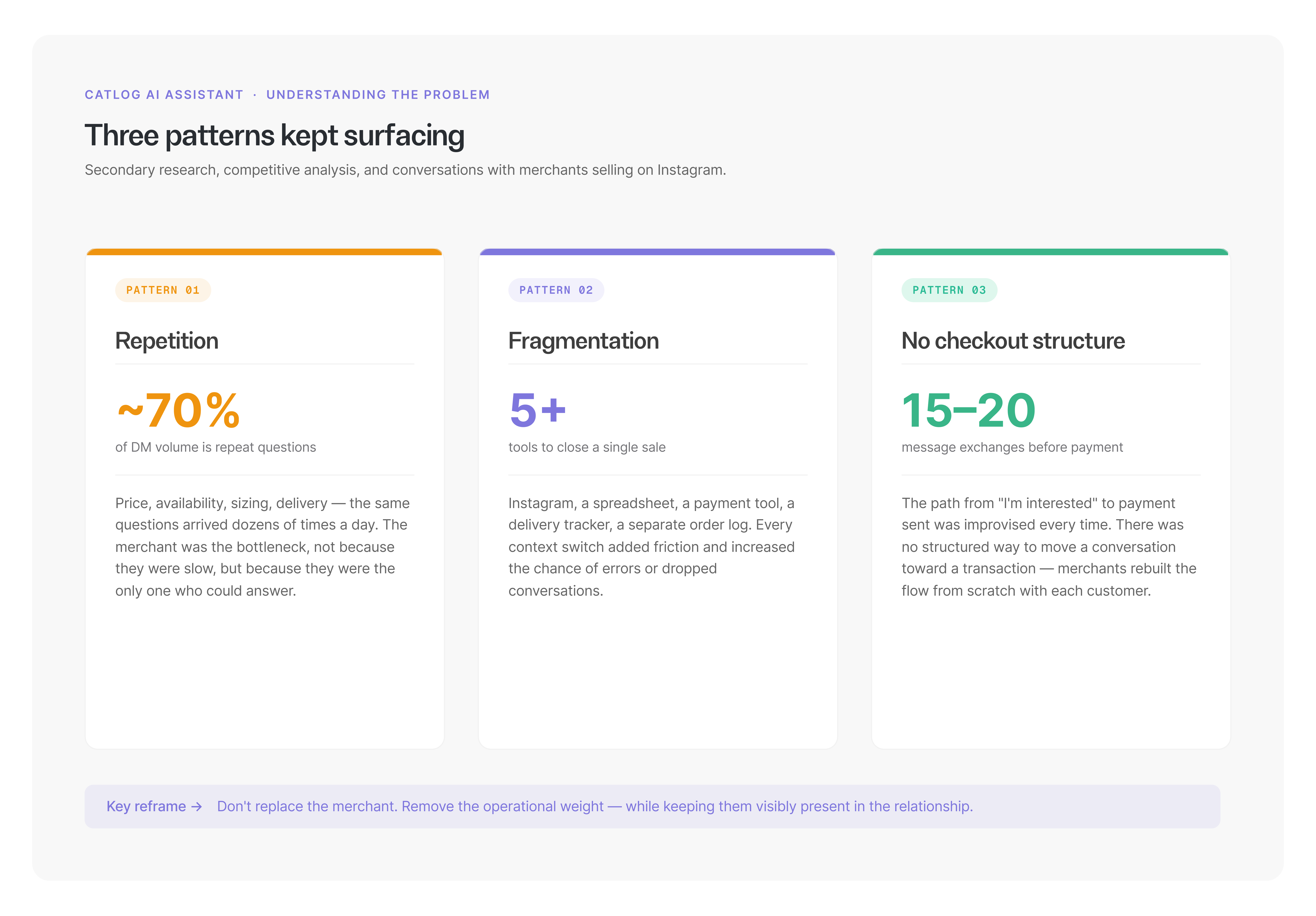
Three patterns kept surfacing:
Repetition.
Fragmentation
No checkout structure.
These problems pointed toward automation, but there was a critical constraint: social commerce in Nigeria runs on trust. Buyers aren't transacting with a brand — they're transacting with a person. Research into consumer behaviour in this market consistently showed that buyers look for signals of human presence, especially at the moment of purchase. A merchant who starts sounding automated erodes exactly the thing that makes the business work.
That reframed the design challenge. It wasn't how to replace the merchant in the conversation. It was how to take operational weight off their shoulders while keeping them visibly present in the relationship.
What We Built
Each problem space pointed to a different kind of design response. Repetition needed intelligence. Fragmentation needed integration. Checkout needed structure. That mapping shaped a three-part system.
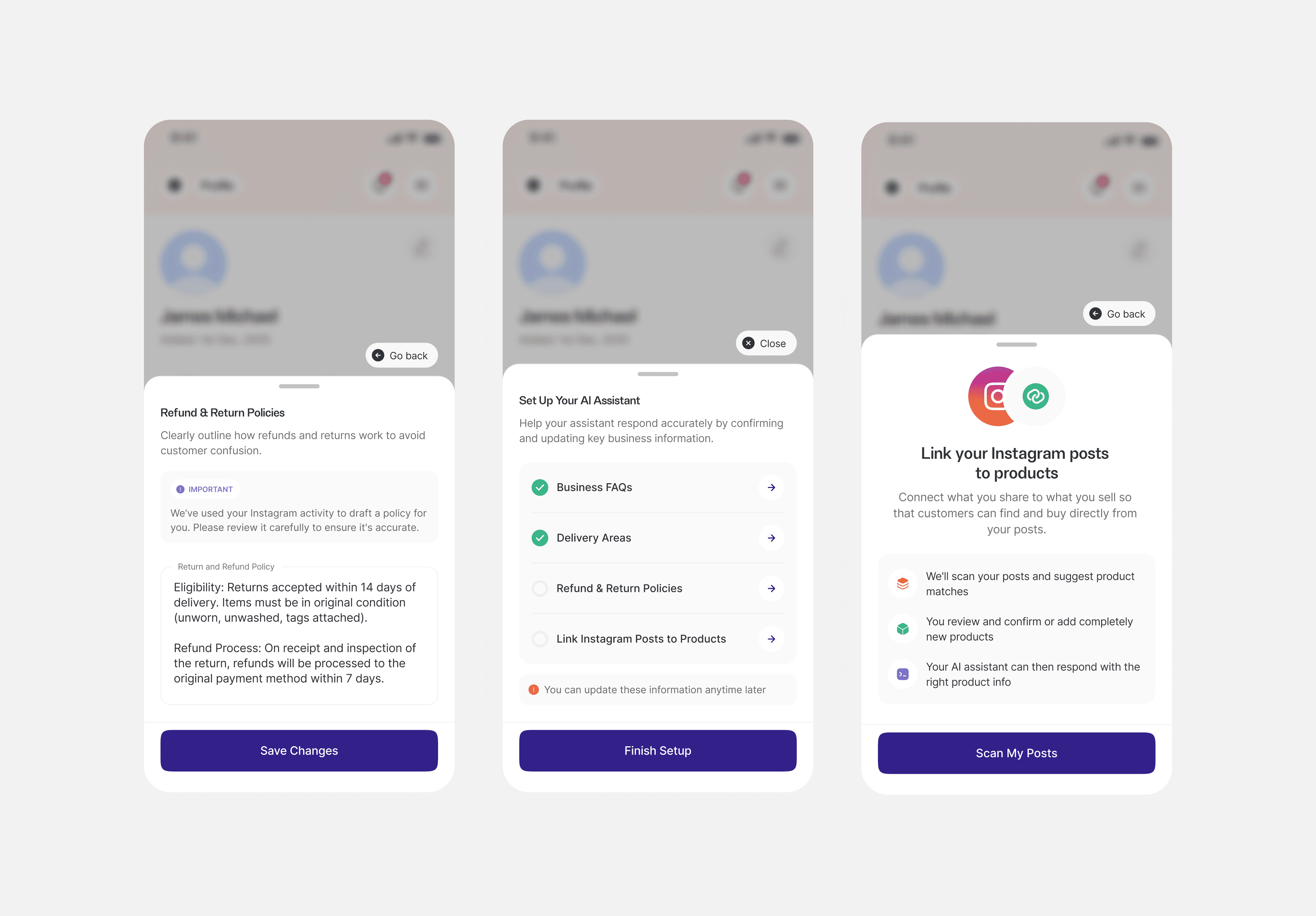
Intelligent Onboarding — Start from what already exists
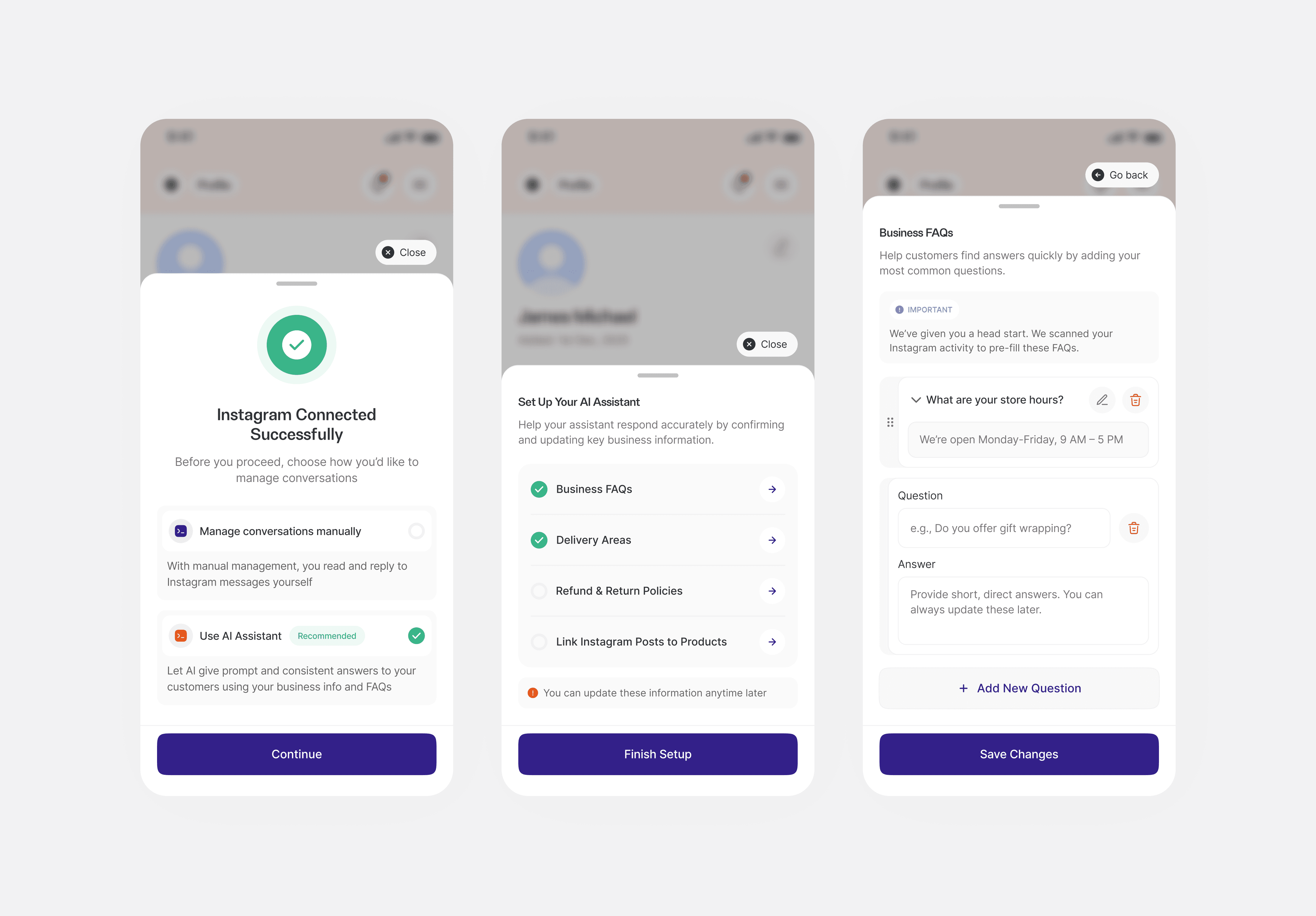
Getting merchants to manually build an AI knowledge base from scratch was never going to work — the upfront cost would cause abandonment before the feature proved any value.
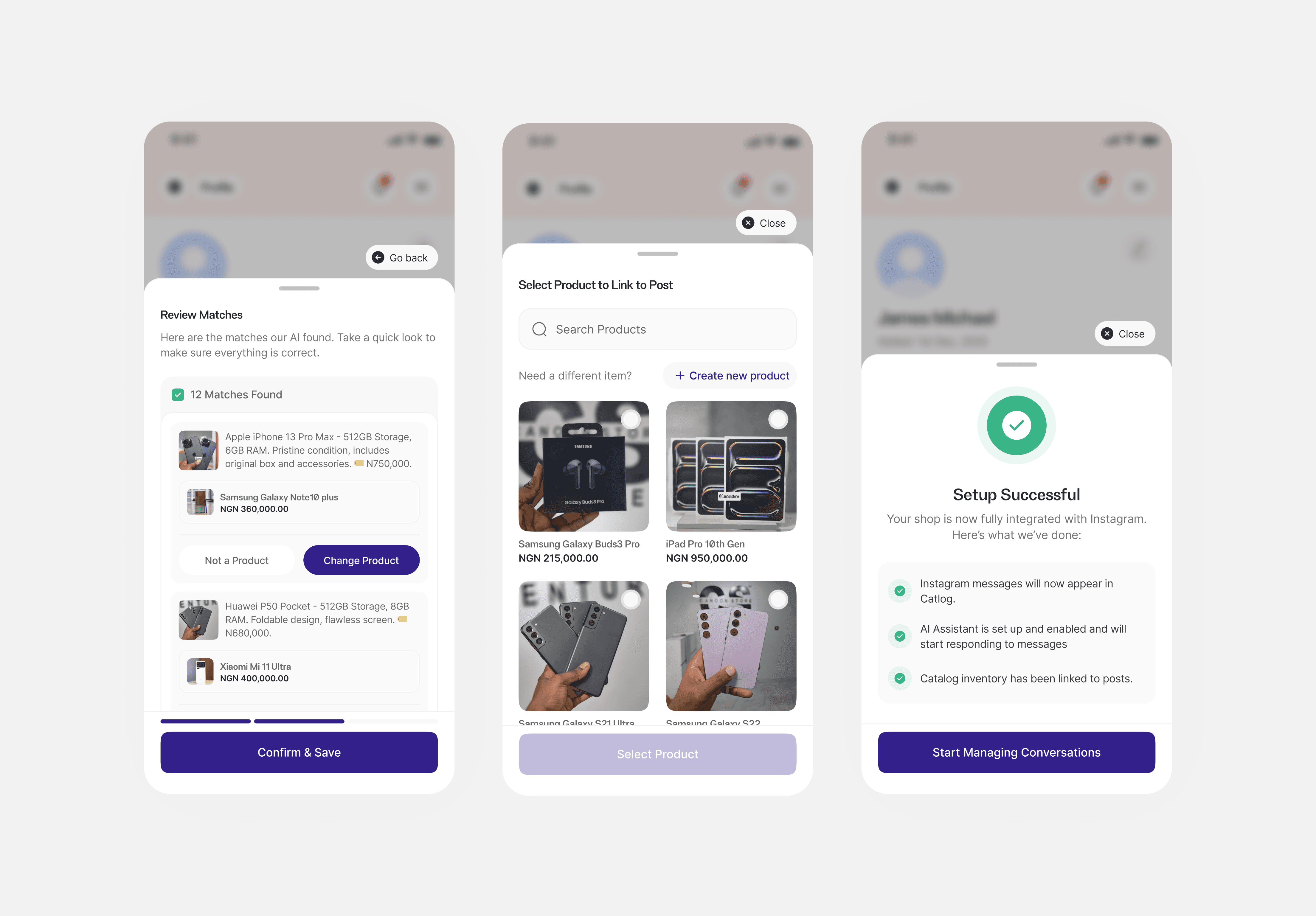
To reduce that burden, onboarding was designed to start from the merchant's existing Instagram presence. Recent posts, captions, and message patterns could be analysed to pre-fill likely FAQs, delivery information, product context, and other business knowledge. Merchants would then review and correct the information instead of authoring everything themselves — shifting setup from a blank-form experience to a review-and-refine flow.
The knowledge base also maps directly to the merchant's existing Catlog product catalogue. Products already in the system don't need to be re-entered. And because customers rarely refer to products by catalogue-style names — they say "the black dress from Tuesday," not SKU 1847 — post-to-product matching handles Instagram-native references.
Unified Chat Interface — The merchant's command centre
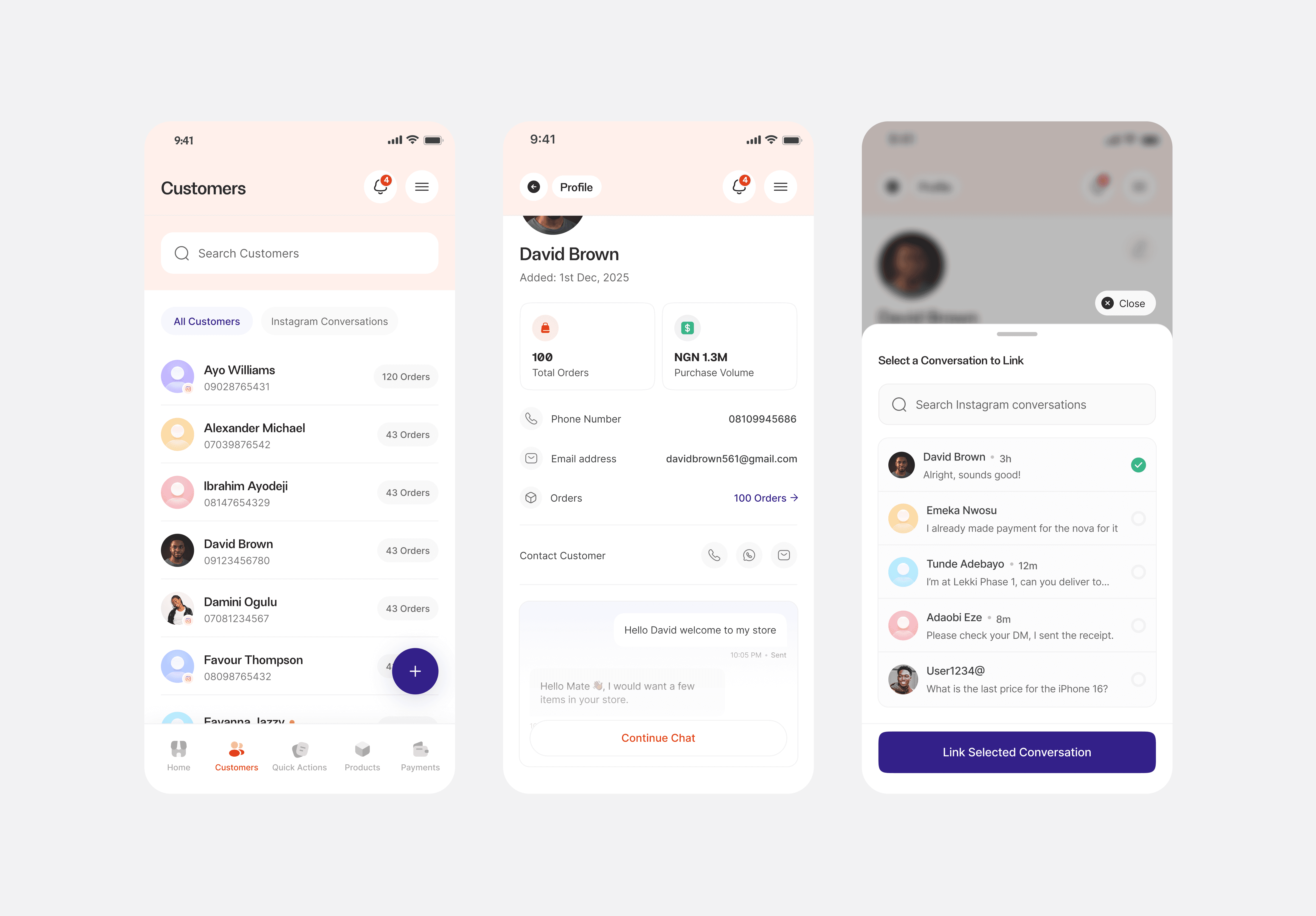
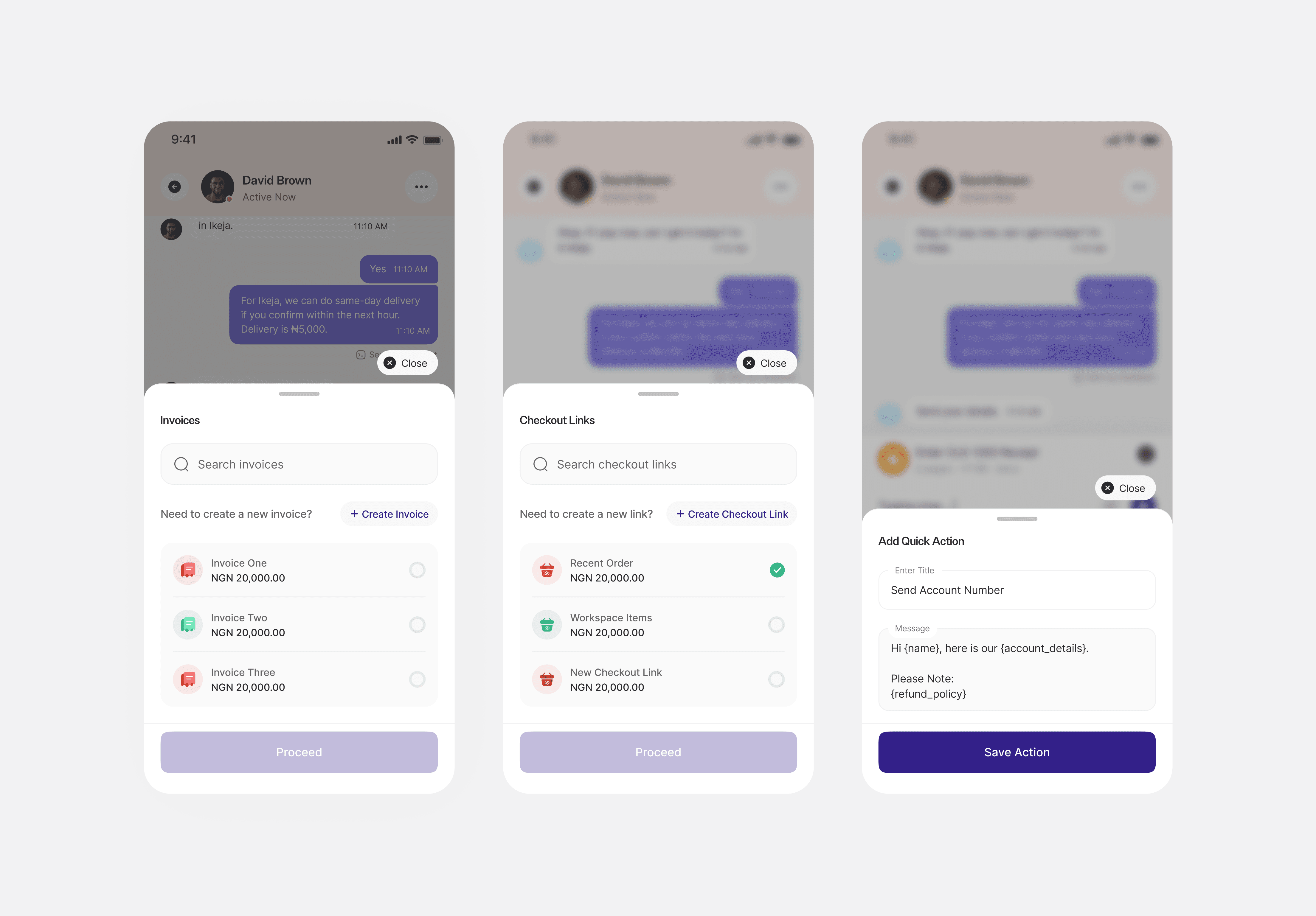
Instead of separating conversation from commerce actions, the chat interface brought both into one place. Merchants could respond to customers while inserting structured actions — product cards, checkout links, invoices, payment prompts, and delivery forms — directly inside the chat.
When a merchant sends a checkout link, it doesn't just go to the buyer. It creates a real order inside Catlog's order management system. The sale is captured and tracked from the moment the link is sent. No reconciliation, no double-entry.

AI Assistant — Assisted, not automated
The assistant was designed as a support layer, not an autonomous seller. Customers communicate in messy ways — short text, shared posts, screenshots, and voice notes — and the assistant needed to work across those inputs while avoiding the biggest failure mode of commerce AI: giving a wrong answer in the merchant's voice.
That made merchant control central to the design.

The confidence model
Working with the engineering team and drawing on AI confidence literature, we defined four response scenarios based on confidence thresholds. The thresholds — 75% for auto-respond, 40% for merchant input — were a starting hypothesis informed by internal discussion and existing approaches to human-in-the-loop AI systems, set to be validated and adjusted post-launch.
The goal was to avoid two failure modes simultaneously: too much automation erodes trust; too many review prompts make the assistant feel useless and get ignored.
Merchant input required.
Used when a customer asked something outside the knowledge base. The system surfaced the question with enough context for the merchant to reply quickly and improve future handling.

Merchant action needed.
Used when the request required a physical or situational action — recording a product video, confirming a visual detail.
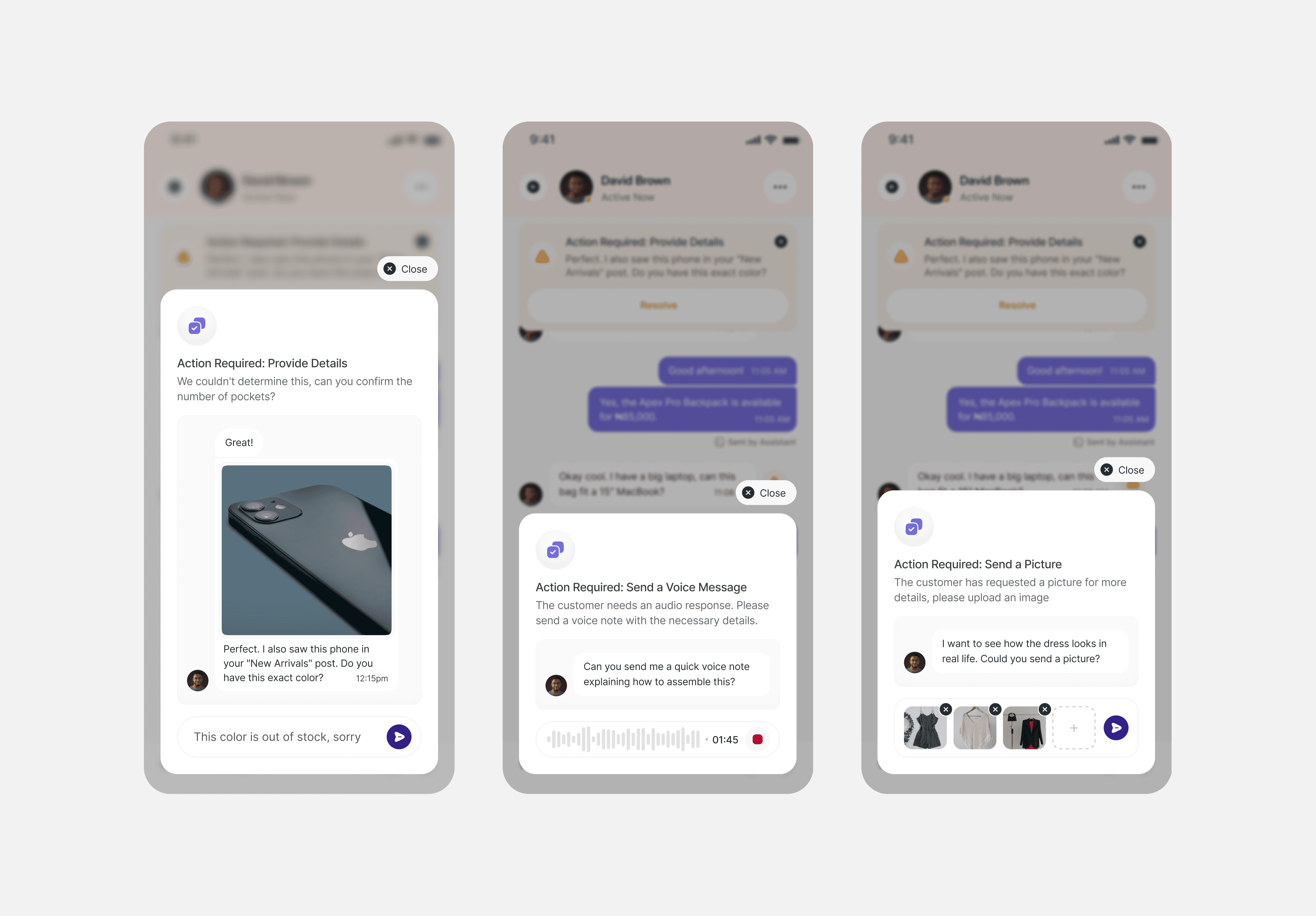
Merchant takeover.
Used when the conversation became too sensitive or complex for assisted handling — complaints, refunds, confusion, or high-value custom orders.

Interaction Principles
The interaction model was designed mobile-first to reflect how merchants actually work. The system prioritized scannable conversation layouts, lightweight prompts, one-handed use, clear states across AI and merchant actions, and structured components over long-form manual input. These principles helped the product feel fast and usable without losing clarity.
Outcome
The project resulted in a connected concept for AI-assisted social commerce: faster setup through business-context extraction, a structured path from conversation to checkout, and an automation model built around merchant control and explicit fallback.
At the time of this case study, the product was still in development — this should be understood as a pre-launch design effort rather than a finalised market outcome. Even so, the concept established a clear direction for how AI could support social selling in a way that felt useful, realistic, and trustworthy.